
Counseling Services
Free, confidential support for all enrolled MCLA students.

Counseling Services is committed to helping students achieve personal and academic
success by supporting students as they navigate challenges, strengthen coping skills,
and enhance overall wellbeing.
Counseling Services provides free, confidential support for all enrolled MCLA students.
A brief psychotherapy framework is used for individual and couples counseling. Other
services include crisis intervention, psychiatric services, consultations, referrals,
outreach, and group counseling as available.
Schedule an appointment
MountainOne Student Wellness Center, 2nd Floor*
8:30 a.m. to 4:30 p.m., Monday through Friday
*Please ask at the Wellness Center front desk if you need to access the elevator.
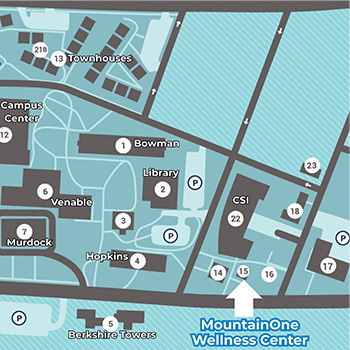
Students are seen at Counseling Services by appointment. To schedule an appointment between 9:00 a.m. to 4:00 p.m., Monday through Friday, email Counseling Services, call 413-662-5331, visit the Wellness Center front desk, or complete the New Client Forms and someone will be in touch with you.
counselingservices@mcla.edu Counseling Intake Forms
after Hours & Emergencies
After 4:30 p.m. and on weekends, please call the Crisis Team of the Brien Center for Mental Health & Substance Abuse Services at 1-413-499-0412 or 1-800-252-0227, or go to the North Adams Campus of BMC Emergency Room.
If you live on-campus, you may also contact the MCLA Department of Public Safety at 413-662-5100, the Admin on-call number (413-663-1594), a Resident Director, or a Resident Assistant.
Counseling Services Team
MSW, LICSW
Ashleigh Hala is MCLA's associate dean and chief wellness officer, providing leadership for Counseling Services, Student Health Services, Health Promotion, Prevention, Peer Education, and the Care Team. Before joining MCLA, she led wellness and prevention initiatives at Wake Forest University and Babson College, where she also served as the founding director of Sexual Assault Prevention and Response Services.
Ashleigh holds bachelor's and master's degrees in social work and is a licensed independent
clinical social worker. She is actively involved in national higher education and
college health organizations, serves in leadership roles with NASPA, and frequently
presents on wellness, prevention, and student support. She is passionate about creating
a campus culture where every student feels supported and has the opportunity to thrive.
LICSW
Claire is a licensed independent clinical social worker (LICSW) and staff counselor at the MCLA Counseling Center, where she has worked for many years. In addition to her role at MCLA, Claire has worked at The Brien Center in Great Barrington, the Bennington, Vermont, school system, and currently serves part time at Greylock Mental Health.
Claire enjoys working with students who are pursuing a specific path as well as those
who are exploring their goals and future direction. She has worked with people from
a wide range of backgrounds and values creating a supportive space where students
can share their stories, reflect on their experiences, and explore how those experiences
shape their lives at MCLA and beyond.
LICSW
With over 25 years of experience supporting the well-being of youth and young adults across the Berkshires, Amrita utilizes a strengths-based empowerment model, empathy, and a trauma-informed approach. She incorporates mindfulness, somatic practices, expressive arts, and essential integration into sessions depending on what each student needs. She is extensively trained in various modalities and offers EMDR, TF-CBT, CPT, DBT, and IFS-IFIO. Whether working with individuals, couples, or groups, Amrita supports students to remember themselves, their innate qualities, and inherent wisdom. All are welcome.
Susannah has served as a medical assistant at MCLA Student Health Services since 2018.
Before joining MCLA, she spent 26 years working in a hospital, where she held a variety
of roles, including transcription and medical coding. Currently, Susannah provides
primary administrative support for the College's wellness departments, including Student
Health Services, Counseling Services, and Health Promotion.
Counseling Resources
24/7 Mental Health Hotlines
Brien Center Crisis Team: Call 800-252-0227
Massachusetts Behavioral Help Line: Online chat; Call or Text 833-773-2445
988 Suicide & Crisis Lifeline: Online chat; Call or Text 988
Crisis Text Line: Text HOME to 741741
Crisis Text Line for Students of Color: Text STEVE to 741741
Call BlackLine (BIPOC): Call 1-800-604-5841; also an app
Trevor Lifeline (LGBTQ+): Online chat; Call 866-488-7386; Text START to 678-678
Elizabeth Freeman Center (domestic violence support): Call 866-401-2425
Love Is Respect (domestic violence support): Online chat; Call 866-331-9474; Text LOVEIS to 22522
RAINN Hotline: Online chat; Call 800-656-4673; Text HOPE to 64673
The Network/La Red (LGBTQ+ domestic violence support): Call 617-742-4911 or 800-832-1901
StrongHearts Native Helpline (Native American domestic violence support): Online chat; Call 1-844-762-8483
Massachusetts Substance Use Helpline: Online chat; Call or text HOPE to 800-327-5050
Warmlines (click links for open hours)
- NAMI HelpLine: Online chat; Call 1-800-950-6264; Text NAMI to 62640; email helpline@nami.org, or mail
- Wildflower Alliance Peer Support Line: Call 888-407-4515
- THRIVE Lifeline: Online chat
- Kiva Centers Peer Support Line: Call 508-688-5898
- Trans Lifeline: Call 877-565-8860
- LGBT National Hotline: Call 888-843-4564
- A Call For Change Helpline (violence prevention): Call 877-898-3411
General College Student Mental Health Resources
- Mindfulness Exercises & Activities
- Active Minds, Student Mental Health Advocacy and Education
Emotional Health and Suicide Prevention Resources
- The Jed Foundation, The nation's leading organization working to promote emotional health and prevent suicide among college students.
- Half of Us, MTV's mental health campaign to address depression and combat suicide among American youth
- Tips for Talking About Suicide
- Myths about Suicide
Substance Use and Recovery
- AA & NA Meetings in North Adams
- Online Alcoholics Anonymous Meetings
- Online Narcotics Anonymous Meetings
Race-Based Traumatic Stress and Psychological Injury
MCLA Screenings
- Brief Wellbeing Assessment
- Blood Alcohol Concentration Personalized Calculator
- Alcohol Assessment
- Cannabis Assessment
- Nicotine Cessation Reflection & Plan
Outside Organization Screenings
FAQs
A: In case of a psychological emergency during business hours (Monday – Friday, 8:30-4:00),
call Counseling Services at 413-662-5331, or walk over to us at 289 Church St.
If this is a psychological emergency outside of business hours, contact MCLA Public
Safety at 413-662-5100, speak to a member of the Residence Life staff, call 988, call
the Brien Center Crisis Team at 1-800-252-0227, or go to your nearest hospital emergency
room.
A: There is no cost for students to use Counseling or Psychiatric care from MCLA. However, if you are referred to an outside provider or given a prescription, your health insurance may need to be used to cover the cost. Emergency Funds can also help cover costs if you require essential needs support.
A: Counseling is a mutual, collaborative process and is most effective when clients
actively participate in establishing and working on treatment goals, completing assignments,
and discussing difficult issues. Your initial session will be an Intake and will involve
an assessment of your needs. Your counselor will offer you some impressions of what
the work will include and collaboratively create a treatment plan. Counseling sessions
are usually scheduled for one 45-minute session every other week, or as clinically
indicated. College campus counseling centers usually have a limit to the number of
sessions per academic year. However, we do not have a limit. Counselors will aim
to be flexible, meet students where they are, and provide support that is culturally
respectful and responsive.
A: Yes, most likely. All enrolled MCLA students (residential, commuter, and graduate)
are welcome to meet with Counseling Services while academic classes are in session.
Students can meet with a counselor in person while on campus or use telehealth if
you are in the state of Massachusetts during the call. However, not every person is
suited for telehealth. We recommend that students meet with their counselor in-person
for the first session to discuss options.
A: Students must provide at least 24 hours’ notice if they need to cancel an appointment
so the time can be offered to another student. If a student repeatedly misses appointments
without notifying Counseling Services, their scheduled time may be reassigned. Students
are always welcome to return to counseling and psychiatric care; however, their original
time may no longer be available.
A: All conversations with Staff Counselors are considered confidential unless you have
specifically given your written consent to a Staff Counselor to share information
on your behalf with a particular person and about a particular topic. Your consent
can always be revoked at any time. State laws and professional code of ethics protect
your privacy as a client. However, there are exceptions to this. In general, all conversations
are confidential unless we determine that you are at risk of hurting yourself or another,
you inform us of child abuse or elder abuse, or if a court of law orders that we provide
certain information. Email correspondence is not considered confidential.
A: Absolutely. We can be a confidential sounding board for your concerns in a counseling
session, and if it is a real concern, we will figure out next steps to support this
person. Some solutions might be to offer resources, or help you complete an anonymous CARE report, or we might suggest that you walk the person of concern over to Counseling Services
to make an appointment. To be transparent, everything you share with a counselor remains
confidential between the two of you unless there is an indication of imminent risk
to the student of concern or someone else. When a CARE report is made on behalf of
a student of concern, Staff Counselors may reach out to the student of concern to
invite them to a session. Whatever is happening, Staff Counselors will assess the
situation to find a solution or the right resource.
While Counselors and Staff cannot confirm or deny who uses Counseling Services without
written consent from students, you are welcome to share your concerns with a Counselor.
You might suggest that your student "give counseling a try" by attending one session.
You might consider sharing the link to our forms to initiate a session. Check out the helpful Mental Health Resources section above
for lots of helpful links and crisis hotlines to call, as well.
If your student is a minor, they will need your signature on New Client forms to initiate Counseling Services. Parents/caregivers/guardians may request access
to student records of minors unless state law or institutional policy states otherwise,
and until the student is no longer a minor. Emancipated minors have expanded rights.
Connect with us

@mclawellness

@mclawellness
