
MCLA Honors Program
Elevate yourself. We'll support you.
The Honors Program supports MCLA’s liberal arts mission by creating a community of curious, engaged students who love learning across disciplines. Here, students pursue interdisciplinary work in small, collaborative settings that encourage deeper thinking and sustained inquiry
Elgibility & Requirements
Any MCLA student may apply at any time to join the Honors Program by meeting with the director. To remain in good standing and receive program benefits, students must maintain a cumulative GPA of at least 3.2 and complete at least one honors course each academic year.
Completion of the Honors Program and graduation with All College Honors require at least six honors courses (18 credits, at least half at the 300 level or higher), with a grade of B or better in each course, and a cumulative GPA of at least 3.2.
Honors Courses
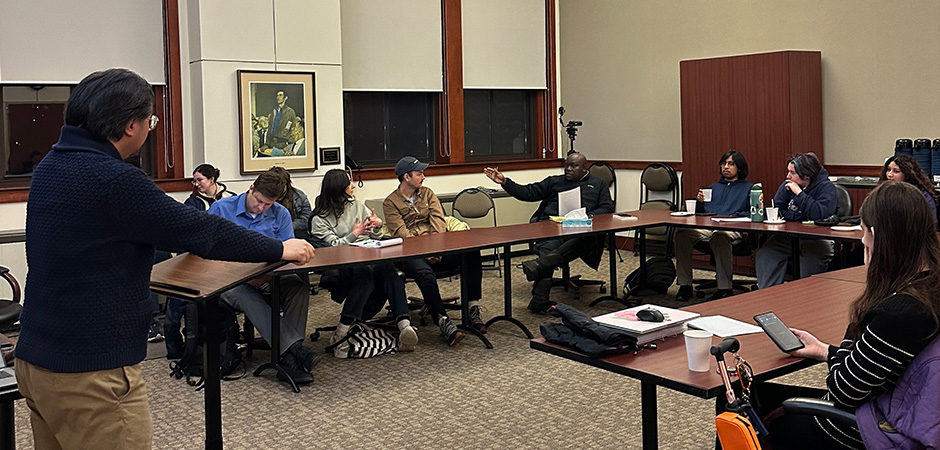
The Honors Program is an academic pathway, similar to a minor, that can be pursued alongside any major—or, with careful advising, a double major. While courses are cross-listed with departments, each is designed as an honors experience: small, participatory, and interdisciplinary, with an emphasis on intensive reading and writing and on both individual and collaborative research.
Spotlight Courses



Research & Scholarship
Commonwealth Scholar
Some honors students choose to graduate as Commonwealth Scholars in addition to completing All-College Honors. This option involves a yearlong process of researching and writing an interdisciplinary thesis, culminating in a public presentation and defense in the spring. Commonwealth Scholars also present at the Commonwealth Undergraduate Research Conference at UMass Amherst.
If you’re interested, begin exploring the option early in your junior year. By the end of that year, you must secure a faculty advisor and submit a prospectus outlining your research topic, methods, interdisciplinarity, bibliography and timeline. Proposals are due to the Honors directors by March 31 and are reviewed by the Honors Advisory Board in early April.
If your research involves human subjects, you must also submit an application to the Institutional Review Board before beginning senior-year research. IRB applications should be submitted by late April.
2026 Commonwealth Scholars
Taboo Fictions: An Autotheoretical Analysis of Rape, Incest, and Other Forms of Harm in Marquis de Sade, Georges Bataille, and Kathy Acker" is an autotheoretical essay that considers the aesthetic and sociopolitical components of so-called “transgressive fiction” in the works of Marquis de Sade, Georges Bataille, and Kathy Acker. Employing literary criticism, psychoanalysis, autofiction, and the theories of transgression and taboo set forth by Georges Bataille and Michel Foucault, the thesis explores fiction that, on the level of both form and content, infringes on social and political limits and operates from the edges of physical and psychic experience. Through my autotheoretical approach, I utilize my experience with sexual violence to examine the aesthetic value and impact of the novels of Sade, Bataille, and Acker, applying Avgi Saketopoulou’s theory of traumatophilia to describe why one might (and why I do) feel drawn to and thrilled by work that pushes the boundaries of what is “supposed” to be written about and how. Ultimately, I want to provide a creative, multi-disciplinary evaluation of the role that taboo-centered literature plays in the lives of writers and readers, and the myriad, sometimes conflicting, ways that this literature might interact with histories (whether individual or collective) of sexual violence and trauma.
"This project has been so deeply pleasurable. I am eternally grateful to have had such an enthusiastic advisor to assist me in my journey of research and creation. It feels as though my entire life, my longstanding creative and intellectual interests, has led to the undertaking of this project, and in that way, the thesis has become my life in a very thrilling and beautiful way. I honestly hope to keep working on this project for a long time, even after my defense when the project has been "finished". My thesis is my most favorite artwork of mine, the fruits of my ecstatic attention to literature, and a labor of great love and struggle."
Between psychology’s schools of thought lies the discourse of attention deficit/hyperactivity disorder (ADHD). The pharmacological industry and public both favor a neuropsychological understanding, limiting integration of psychodynamic theory. This paper analyzes symptoms of ADHD and 'rejection sensitive dysphoria' through Kohut’s narcissistic wound framework. The discourse of these 'conditions' and its consequences is examined using various theories, including dynamic nominalism. How language may be used to perpetuate symptoms through the promotion of diagnostic identity, the oversimplification of symptoms and their origins, and the lack of evidence-based practice are all also analyzed. A comprehensive internet search on the evolution of ADHD and rejection sensitive dysphoria was conducted, alongside a social media search using the phrase “rejection sensitive dysphoria,” limited to content posted by licensed professionals. Claims without substantial evidence appeared in every post, including inflated prevalence rates and faulty explanations, sometimes framed as diagnostic criteria. The avoidance of psychodynamic theory and practice, and promotion of pop psychology to the general public seen in the case of rejection sensitive dysphoria is reductive and harmful, leaving care limited to those seeking it.
"I am incredibly grateful that I was given the opportunity to complete a Commonwealth Honors Thesis. Being part of this program allowed me to challenge myself and further explore a topic that interests me by taking an interdisciplinary approach. It has helped prepare me for a doctoral clinical psychology program which I'll be starting in the fall. My advisor helped me through every step of the way, and the topics we engaged with will stick with me throughout my academic and professional careers. My hope is that more students apply for this experience in the coming years and that it inspires them as much as it did me."
Commonwealth Scholar FAQs
Upon approval from the HAB, students and their faculty advisor should send an email to the registrar (copying the Honors Directors) stating:
“The student STUDENT NAME has been officially approved to enroll in HONR 550: Commonwealth Honors Thesis Research in SEMESTER-YEAR. I'm copying the co-directors of the Honors Program, NAME(s). NAME will be serving as the faculty sponsor for this Honors Thesis.”
Upon approval by the honors directors, the student will again enroll in HONS 550 for the Spring semester using the same process. HONS 550 is a 4-credit course, so a Commonwealth Scholar Research Thesis totals 8 credits.
Typically, students complete research (data collection, interviews, archival work, etc.) by the end of the Fall semester. They can also produce early drafts of writing. At the end of the Fall semester, Honors Directors ask the students to submit a report, signed and approved by their faculty advisors. The directors also meet with students to discuss progress and begin selecting a thesis committee for them. The committee typically includes the faculty advisor, one Honors Director, and a third reader (ideally an external reader, though exceptions can be made as long as the reader is from a different discipline than the students' own). The faculty advisor should help students find their third (external) reader.
The spring semester mostly involves finishing writing and preparing presentations (MassURC, URC, and thesis defense). A completed thesis should be submitted to the Honors Directors and the committee at least two weeks prior to the defense. The committee will all be present (Zoom/Teams option for external readers) in late April, when the thesis defense takes place. The thesis/presentation is graded on a pass/fail basis. The committee will decide via a vote at the end of the presentation in April.
HONORS CO-DIRECTORS
MOHAMAD JUNAID
Co-director and Associate Professor of Anthropology
mohamad.junaid@mcla.edu
Honors Student Council
Honors Advisory Board
FAQs
Part of the point of the program is to get students out of their comfort zones, doing intensive intellectual work in areas beyond their specialties (and bringing the investigative tools of those specialties to other subject-matters). Thus it is actually best to select most of your honors courses outside your major or division.