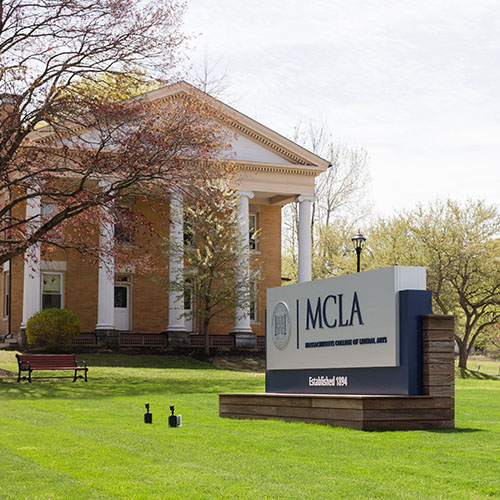
Financial Aid FAQs & Resources
Answers to the questions students and families ask most often about paying for MCLA.
These answers are designed to help students and families understand costs, scholarships,
grants, loans and the steps involved in applying for aid.
Scholarships & Grants
Every student who applies for admission is automatically considered for institutional merit scholarships. There is no separate scholarship application. Merit awards are based on high school academic performance for first-year applicants and on college coursework for transfer applicants. Need-based grants are awarded through the FAFSA. Complete both steps: apply for admission, then file the FAFSA.
Applying for Aid
Complete the FAFSA for each academic year you want to be considered for aid. Eligibility is recalculated annually because it depends on changing circumstances. If your family's financial situation changes significantly after filing, contact the Office of Student Financial Services to request a review. Federal regulations allow aid administrators to adjust the data used to calculate eligibility when documentation supports the change.
Understanding Student Loans
Federal Direct Subsidized Loans are available to eligible undergraduates with demonstrated financial need, and the federal government generally pays the interest while the student is enrolled at least half-time. Federal Direct Unsubsidized Loans are available regardless of financial need, and interest begins accruing after disbursement. Federal interest rates change by award year, so the page should link to the current federal rate rather than hard-code an unconfirmed figure.
FAQs
General
No. Every student who applies for admission to MCLA is automatically considered for
institutional merit scholarships, with no separate scholarship application required.
Merit awards are based on high school academic performance for first-year applicants
and on college coursework for transfer applicants. Students should also complete the
FAFSA to be considered for federal and state need-based aid programs.
The bill is the amount MCLA charges directly, while cost of attendance is a broader
financial aid budget that also includes estimated non-billed expenses. Students should
review current waiver information to determine whether that charge applies to them.
Yes. Students must submit a new Free Application for Federal Student Aid for each
academic year in which they wish to be considered for federal, state, or institutional
need-based aid at MCLA. Eligibility is recalculated annually because it depends on
financial circumstances that change from year to year. Merit scholarships awarded
at admission follow their own renewal criteria and don't depend on the FAFSA.
The 2026-27 FAFSA is available now.
We recommend completing the FAFSA and your financial aid file as soon as possible
after October 1. Applications completed by January 1 will have priority for the funds
available.
Not necessarily. The FAFSA must be completed every year as soon after the October
1 date as possible. It may be possible to receive a comparable award if the family’s
financial situation has not changed from the prior year and all required paperwork
has been completed as soon as possible after October 1.
In most cases for undergraduate students, yes. In the eyes of the FAFSA, you are considered either a dependent student or an independent student. The FAFSA asks you questions to preliminarily determine your status.
If you live on your own by choice, do not meet any of the independent questions on the FAFSA (24 years old, veteran, etc.) and maintain a relationship with your parents, you will have to include parental information.
If there has been a breakdown in the relationship with your parents, you can complete a written independence appeal directly through Student Financial Services. This consists of a written letter from you detailing your circumstances regarding your relationship with your parents, along with two supporting letters from “responsible adults” (e.g. therapist, school counselor, clergy.)
All students in a graduate program are considered independent students.
The student will use the parent’s information that they reside with the most during
the calendar year. If that parent is remarried, the step-parent’s information is also
included on the FAFSA. If the student splits their time 50/50 with both parents, then
they will use whichever parent contributes 51% to their support.
Both of their information is required on the FAFSA.
If you have a legal guardian that has been appointed by the courts, you will complete the FAFSA as an independent student and the guardian’s information is not required. The College may require a copy of the legal document.
If you live on your own by choice, do not meet any of the independent questions on
the FAFSA (24 years old, veteran, etc.) and maintain a relationship with your parents,
you will have to include parental information. If there has been a breakdown in the
relationship with your parents, you can complete a written independence appeal directly
through Student Financial Services. This consists of a written letter from you detailing
your circumstances regarding your relationship with your parents, along with two supporting
letters from “responsible adults” (e.g. therapist, school counselor, clergy.)
It means that you will have to submit verification documents to the school. This may
include a verification form and copies of yours and your parent’s tax return transcripts.
This does not mean copies of the tax returns. You can request copies of the tax return
transcripts by calling 1-800-908-9946. You also have a choice to correct your FAFSA
and complete the IRS data retrieval. This will pull the IRS information for the tax
returns. You would then submit your FAFSA as a correction and MCLA would receive the
information electronically.
If you're a first time borrower of the loan, you will need to complete the online entrance counseling and Master Promissory Note on www.studentaid.gov. These will be available once your student loan has been processed by the College's Financial Aid Office, beginning in June. You will receive an email when that process can be completed.
If you are a prior borrower at a different college, you may only need to complete
the online entrance counseling. The Master Promissory note is active for up to 10
years.
There are several options available. You can apply for an alternative student loan, which is credit based and will require a credit-worthy cosigner. Additionally,
the balance can be financed through a monthly payment plan by Nelnet. You can choose to do any of these or a combination of them. Whatever works best
for you and your family.
The cost of attendance is what it costs the student to live and go to school for 9 months. This not only includes the direct costs of tuition, fees, housing, and food, but also books, transportation, and personal expenses.
It's very important to note that the cost of attendance is not a bill. The cost of
attendance is a larger figure used by Student Financial Services when determining
the amount of financial aid a student can receive.
Fall semester bills are mailed and eBilled in early July with an early August due date. Spring semester bills are due in mid-November with a mid-December due date.
Accepted aid will show as a credit on your bill. However, if you accepted federal
student loans and are a first time borrower, you will need to complete Entrance Counseling
and a Master Promissory Note. You will be notified by Student Financial Services when
you can complete this, but no federal loan will show on your bill until this is done.
Yes, if your financial aid exceeds your billed charges, you can request a ‘book advance’ from Student Financial Services. Book advances are available upon request only after you complete any required paperwork for your financial aid file. Whatever you request as a book advance would be deducted from your refund.
If you are interested in a book advance, email StudentAccounts@mcla.edu after the
bills go out to be put on the list. You will be notified of the next steps.
Refunds normally occur by mid-October and early March for each semester. If you are
enrolled in a degree completion program, Graduate Program, MBA Program, the Early
Childhood Program, or any other cohort program, refunds may occur at a later date
due to enrollment verification. It is recommended to check with Student Financial
Services if you need to know a specific date.
If you were eligible for the workstudy program, it would be listed on your financial aid award for the upcoming academic year.
No. If you are awarded workstudy, you will receive a bi-weekly paycheck for your worked
hours.
We strongly recommend that any student looking for an on-campus job visit Student Employment. You would want to look for non-workstudy positions on this page.
Yes. MCLA offers many on-campus and off-campus job opportunities. Many MCLA students
are awarded work study funds as part of their financial aid package.
Per federal regulations, you may repeat a course and receive aid for it if you have
never passed the course. If you previously passed the course, you may receive one
repetition and receive aid for it. Any second or subsequent repetition will not qualify
for financial aid.
We know that your tax returns may not reflect you or your family's current financial
situation. If something recently happened to impact your financial situation, our
Office of Student Financial Services may be able to help. Please contact finaid@mcla.edu.
External scholarships are available through national scholarship databases, state
aid programs, employers, community organizations and professional associations. Students
should be aware that legitimate scholarship applications never charge a fee, and any
service asking for payment to apply or to search should be treated with caution. MCLA
students are automatically considered for institutional merit scholarships when they
apply for admission, with no separate application required.
Scholarships, Grants, Work-Study & Student Loan
No separate application is required for MCLA institutional merit scholarships. Admission
applicants are automatically considered, with first-year awards based on high school
academic performance and transfer awards based on college coursework. Students should
also complete the FAFSA to be considered for eligible federal and state need-based
aid.
Grants are financial aid that doesn't require repayment and are awarded primarily
on financial need, including federal Pell Grants, Supplemental Educational Opportunity
Grants and state MASS Grants. Federal Work-Study provides part-time employment during
the academic year, and students earn wages for hours actually worked. Loans must be
repaid with interest after leaving school. All three are accessed by completing the
FAFSA, and a student's aid offer may combine them.
No. Federal Work-Study is earned rather than credited. Students are paid wages for
hours worked, usually on a regular payroll schedule, and use those earnings for ongoing
expenses such as books, transport and personal costs. The award amount represents
the maximum a student may earn over the year, not a sum deducted from the bill. Students
should budget for the full billed amount and treat work-study earnings as income received
over the course of the term.
MCLA students may be eligible for federal Pell Grants, Federal Supplemental Educational
Opportunity Grants and Massachusetts state grant programs, depending on financial
need as determined by the FAFSA. Grants don't require repayment. Students are also
automatically considered for MCLA institutional merit scholarships when they apply
for admission, with no separate application required.
Student Debt
Students can reduce borrowing by completing the FAFSA each year to access grant aid
that doesn't require repayment, and by taking advantage of institutional merit scholarships,
for which all admission applicants are automatically considered.
Federal student loan borrowers can identify their loan servicer by logging into their
federal student aid account, which lists all federal loans and the servicer assigned
to each. Servicers can change, so borrowers should verify their servicer before making
a payment or applying for a repayment plan. Private loans aren't listed there and
must be tracked through the original lender or a credit report.
Financial Aid Resources
External resources that complement our own aid programs. Every student who applies for admission is automatically considered for institutional merit scholarships. There is no separate scholarship application. Complete the FAFSA to be considered for federal and state need-based aid.
External scholarships and planning tools can be useful additions to the aid you receive from MCLA, federal programs and state programs.
Additional Scholarship Resources
Coming soon
Be cautious of scholarship services that charge a fee to apply, promise a guaranteed award or ask for payment to search on your behalf. If you're unsure whether an opportunity is legitimate, contact the Office of Student Financial Services before providing payment or personal information.
Available State Aid
Coming soon
Planning Tools
Coming soon