Tax Season, Community Purpose: MCLA Students Bring Free Tax Help to Northern Berkshire
April 10, 2026
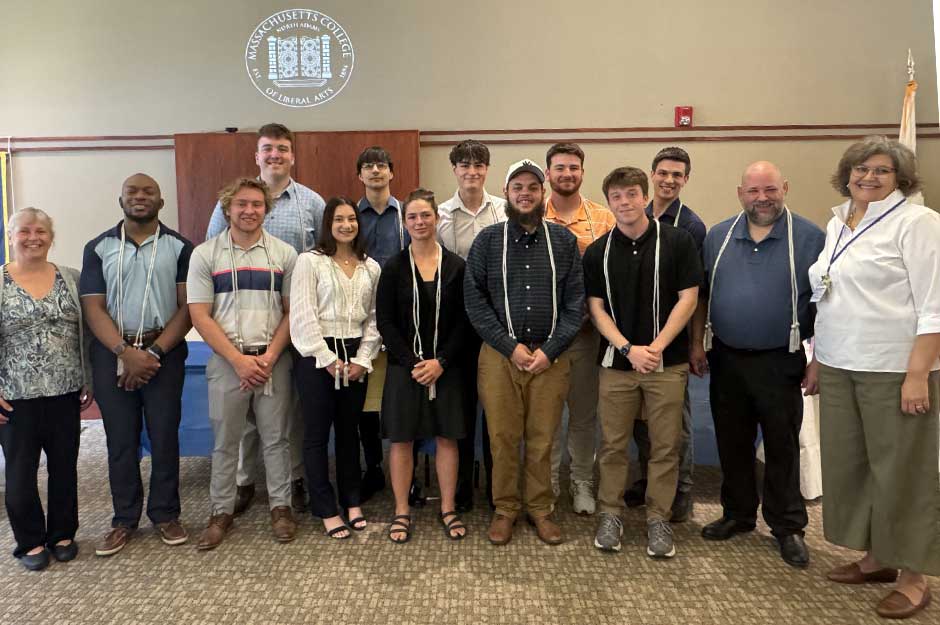
For accounting students at Massachusetts College of Liberal Arts, tax season is more than a classroom concept. It is a chance to make a real difference in their community.
For the eighth consecutive year, MCLA's Department of Business Administration has partnered with Habitat for Humanity to offer free tax preparation services to qualified Northern Berkshire residents through the IRS's Volunteer Income Tax Assistance (VITA) program. The program runs through April 15, 2026, with students seeing clients every Monday and Wednesday from 4 to 8 p.m. in the Murdock Hall Business Suite, Room 102, at 375 Church Street in North Adams.
To participate, students undergo rigorous IRS training over winter break to become IRS certified, followed by in-person training throughout January and into early February. They work under the supervision of Professor Tara Barboza, a Certified Public Accountant and MCLA accounting faculty member. Each student reviews every return themselves, then Assistant Site Coordinator Paul Duby-Fisher conducts a secondary review, and Professor Barboza completes the final check before any return is filed.
For Thomas Rice '26 and Troy Michalak '26, two seniors completing concentrations in accounting and finance, VITA has been a turning point. Troy came to MCLA planning to study engineering before switching to accounting, inspired by an uncle who is a CPA. Thomas, originally from New York, credits the program with connecting him to the Northern Berkshire community in ways that went well beyond the classroom.
"VITA was one of the best choices I made in my college career," said Rice. "It allowed me to connect with and help local people who I would have never interacted with otherwise."
Both students appreciated being able to help clients who might not have $500 to pay a private accountant. A wide variety of clients came through, and students got to sit down, get to know them, and have real conversations. "We had a fun time getting to know the clients," Troy said. "A lot of CPAs don't necessarily sit down with their clients anymore, and the clients were so happy that we did."
For Troy, VITA also reconnected him to something he had missed. As a kid he had volunteered as a soccer coach and in town programs, but college had crowded out that kind of involvement. "I felt very much like I was contributing to Northern Berkshire County," he said.
The experience has also proved formative professionally. Both students now intern at Adelson and Company, where Thomas performs municipal auditing for towns in the region, a position he traces directly back to his time with VITA.
"I know that VITA was a big reason for why I got the job," said Rice. "Having prior experience really showed that I was ambitious and wanted to learn."
Troy agrees. "If you have VITA on your resume, the employer will realize the student already has experience doing taxes for a whole tax season. Plus, you are showing you care about your clients and your community."
Rice also speaks to the quieter, less obvious skill VITA builds: the ability to sit with a client, hold a conversation, and put someone at ease while their return is being reviewed.
"My confidence definitely grew because of VITA," said Rice. "At first, I struggled to keep conversations going during the long wait times. But as the tax season went on, I got better and better. By the end, I was able to hold conversations and had a few topics that would always keep things rolling."
Both students also serve on the business department's academic advisory board, where VITA came up in a recent discussion about internship requirements. The takeaway was clear: the program is too valuable not to encourage. "There are only so many semesters you can do internships," Troy said, "and this one is a very safe way to learn."
That combination of technical skill-building, community engagement, and professional confidence is exactly what Professor Barboza has observed in her students year after year.
"They earn college credit, all while volunteering in our community, and build a sense of belonging, confidence, and soft skills that will serve them throughout their college and professional careers," said Barboza.
The program is available at no cost to individuals and families earning $69,000 or less annually, as well as those with disabilities, limited English-speaking skills, or individuals over the age of 65 with retirement or pension income.
Residents interested in scheduling an appointment should call Habitat for Humanity at 413-442-3181 to determine eligibility.