
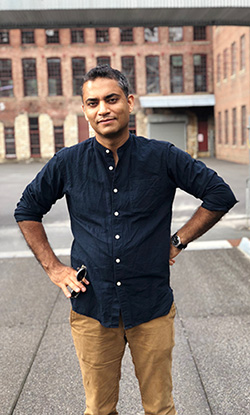
Dr. Mohamad Junaid
Associate Professor, Sociology, Anthropology, Social Work
- mohamad.junaid@mcla.edu
- Phone
- (413) 662-5189
- Office
- Murdock Hall 326
Education
Ph.D., The Graduate Center CUNY, 2017
M.Phil., Jawaharlal Nehru University
(India), 2008
M.A., Jawaharlal Nehru University, 2006
B.A., Aligarh Muslim University, 2003
Courses Taught
ANTH 130: Introduction to Sociocultural Anthropology
ANTH 210: Visual Anthropology
ANTH 304: Environmental Anthropology
ANTH 306: Cross Cultural Documentaries
ANTH 395: Ethnographies of South Asia
ANTH 395: Anthropology of Violence
ANTH 475H Honors: Religion and Ritual
ANTHROPOLOGY
About Me
I am an anthropologist with a strong belief in teaching as crucial to creating a just, sustainable, and pluralistic world. I seek to inspire students to build a critical understanding of socio-political questions in local and global contexts and to appreciate the interconnectedness of human and non-human worlds. I provide students with intellectual tools to nurture open-mindedness and to develop new modes of thinking. In my classes, I use a combination of social theory, ethnographic texts, and documentary films to illuminate anthropological approaches to cultural difference and questions of inequality and power, as well as to the discipline’s creative and imaginative potential.
Research/Creative Interests
I specialize in the study of political subjectivity, violence, and the effects of military occupations. My lived experiences in the US, India, and Kashmir have significantly influenced my research. I examine questions like the persistence of colonial structures in postcolonial states, the aporias of democracy and self-determination, the revisionist nature of South Asian historiography and the political memory in the margins, the spaces and infrastructures of control, and visual politics. My prior ethnographic research, supported by grants from the Wenner Gren Foundation and the Social Science Research Council, examined the history of political activism and state violence in Kashmir. I also participate in public scholarship related to Kashmir, contributing to debates on settler colonialism, indigenous sovereignty in the region, as well as the rise of religious right-wing and imperial nationalisms in South Asia.
Publications
“Kashmiri Futures: A Beginning.” Special Issue: Kashmiri Futures. English Language and Notes, Ed. Mohamad Junaid, Deepti Misri, Ather Zia. 61:2: 1-13. DOI 10.1215/00138282-10782010
“Tehreek history writers of Kashmir: reconstructing memory at the margins of postcolonial empire” (book chapter) Routledge Handbook of Critical Kashmir Studies. Eds. Mona Bhan et. al., pp. 252-267. London and NY: Routledge.
“The price of blood: state, precarity, and the moral discourse of loyalty in Kashmir.” Comparative Studies of South Asia, Africa and Middle East. (2020) 40 (1): 166–179.
“Counter-maps of the Ordinary: Occupation, subjectivity, and Walking under Curfew in Kashmir.” Identities: Global Studies in Culture and Power. DOI: 10.1080/1070289X.2019.1633115
“Disobedient Bodies, Defiant Objects: Occupation, Necropolitics, and the Resistance in Kashmir.” The Funambulist: Politics of Space and Bodies, Issue 21, January-February.
Junaid, Mohamad. 2018. “Epitaphs as Counterhistories: martyrdom, commemoration and the work of graveyards in Kashmir.” In Resistance Occupation in Kashmir (The Ethnography of Political Violence), eds. Haley Duschinski, Mona Bhan, Ather Zia, and Cynthia Mahmood, 248-277. Philadelphia: University of Pennsylvania Press.
Junaid. Mohamad. 2013. “Death and Life Under Military Occupation: Space, Violence, and Memory in Kashmir.” In Everyday Occupations: Experiencing Militarism in South Asia and the Middle East, ed. Kamala Visweswaran, 158-190. Philadelphia: University of Pennsylvania Press.
Junaid, Mohamad. 2010. “Elephant in the Room: Debate over Right of Secession.” Economic and Political Weekly XLV, no. 50.
Talk/Presentation
“Logo Maps and Geo-Bodies: The New Hindutva State in India.” Works-in-Progress Series, Minds Eye. MCLA, Apr 18, 2023.
“Surveillance as a Colonial Modality of Terror.” Society for Cultural Anthropology, AAA, Keynote address, June 2022.
“Land in the Settler Colonial Imaginary.” Funambulist and Social Theory Center, University of Warwick. May 23, 2022.
“Allochronization under the emergent settler colonialism in Kashmir.” Roundtable: Asian American Studies and the Kashmir Question, Annual Conference, Association of Asian American Studies, Boston, MA, April 18, 2025.
“Ethnographic Fictions and Literary Kashmir,’ Panel on New Directions in Kashmir Studies,” 52nd Annual Conference on South Asia, University of Wisconsin, MD, Oct, 2024.
“Interpreting the “silence”: Kashmir in the post-2019 era.” Panel on ‘Democracy, Violence, and Constitutional Order in South Asia and beyond.’ South Asia Studies Council, Yale University, April, 2022.
“The Undesirable State Subjects: Resettlement Act and the Citizenship Question in Kashmir.” Panel on Afterlives of Decolonization. 12th Annual Global South Asia NYU Conference, New York, Feb 28-29, 2020.
“‘Finish us all at once!’: violence and the work of time under military occupation in Kashmir.” Slow: a symposium in praxis and theory. Mass MOCA and MCLA, Nov 1, 2019.
“State-Making as War-making: Delusional States in South Asia.” Roundtable panel at Annual Conference on South Asia, University of Wisconsin, MD, Oct 17-20, 2019.
“Internal insecurity: Ikhwan, elections, and the state of emergency in Kashmir.” Panel on Security Empire. American Anthropology Association, Annual Meetings, Washington DC, Nov 29 - Dec 3, 2017.
“State of Emergency, State of Elections: The Social Meanings of ‘Democracy’ in Kashmir.” Panel on Ethnography of Political Process: the aporias of democracy and elections in India. Annual Conference on South Asia, University of Wisconsin, MD, Oct 26-28, 2017.
“Lines of control: military spatialization, violence, and Tehreek resistance in Kashmir.” American Anthropology Association, Annual Meetings, Denver, CO, Nov 18-22, 2015.
“Research in ‘Conflict Zones’, Methodological Pluralism, and Rethinking Philosophical Concepts in Ethnographic Research.” Seminar on Occupational Hazards: Theories and Methodologies. Department of Sociology, University of Warwick, UK, May 9-10, 2015.